
Showing posts with label Born in the USA. Show all posts
Showing posts with label Born in the USA. Show all posts
Tuesday, August 9, 2016
Arcade Fire - "Born In The USA", WayHome Festival
Springsteen enthusiasts Arcade Fire played yet another tribute to their idol last July at the WayHome Festival in Ontario. True to their hipster nature, the Canadian band sang a few lines of "Born In The USA", at a Canadian music festival. Unfortunately, it is tough to tell whether the video is of poor quality, or if the performance itself wasn't very good (I'm leaning towards the former). This, however, leads me to a rant that I'm sure many fans of going to concerts can relate to.
Whenever you see a live band, the pit will be littered with people holding up their cell phones to record the show. While some musicians will try to ban them, it's a battle that is long over; love them or hate them, the smartphones are there to stay. I have two conflicting thoughts on this issue. My heart says that people should put down their phones, live in the moment, and enjoy the amazing performance that they paid good money for. However, my brain says: who I am to tell people how to enjoy the show? And, haven't I posted hundreds of articles using recordings that people made at concerts? Touché, Rorybrain.
However, let's be realistic - there's a happy medium. For the dozens of cameras at every concert, there's only maybe 1-2 good quality videos from any show that I can find online. The success rate of recording is poor. So, I'd ask all amateur concert historians to take an honest look at their abilities. Are they producing quality concert footage? Is it worth the distraction? Can they improve the moments they capture? If smartphones plan to be a permanent feature at concerts, the least we can do is improve their output.


Wednesday, October 28, 2015
Springsteen Coasters!
It's a little early to do another holiday gift guide for this year, but once you see what I recently received, you'll understand why I had to share (and slightly brag) in late October. Given to me by infrequent blog contributor and creator of the creator of the blog - my mom - we have a set of four Bruce Springsteen coasters!

Each coaster is adorned with an iconic Springsteen album cover, starting with his debut album and ending with 1984's Born In The USA. While one may complain about the omission of Darkness On The Edge of Town, I'd counter by saying your complaining over something so trivial is why we can't have nice things.
While I've broken down these albums in every conceivable way, let's rethink the way we see these albums. And, by that, I mean: what types of beverages would these albums best support?

Greetings From Asbury Park: With this postcard picture, I can't help but think of summer vacations. Therefore, a summer-y drink is the clear choice for this coaster. Putting hot cocoa on this coaster would be a grave sin.
Recommended Drinks: Lemonade, Margaritas, Bud Light Lime, Anything That Has An Umbrella In It

Born To Run: This is the piece-de-resistance of the coaster set. You aren't going to just put any old drink on this; it has to be a SPECIAL drink. This is the coaster you bust out when the pope comes to town.
Recommended Drinks: Fancy Wine, Fancy Beer, Fancy Whiskey, That Bottle Of Champagne You've Been Saving To Open When The Mets Win The World Series

The River: Boy, Bruce does not look good on this cover, and the coaster adds to his misery by punching a hole right through his nose. This is the coaster you use after a long night of partying. Put your hangover cure on this coaster, and every time you lift your drink up, you see Bruce staring back at you, with no judgement in his eyes. He's been there, man.
Recommended Drinks: Water, Diet Coke, Smoothies, Hair Of The Dog
Born In The USA: Don't be distracted by that awkwardly placed hole. This is a pure-American coaster, and the drinks it supports will encapsulate the country - freedom, freedom, eagles, baseball, and freedom.
Recommended Drinks: Cheap American Beer, Whole Milk
Unfortunately, it appears this particular set of coasters is difficult to find for sale on the Internet, so I apologize if I got you excited for nothing. However, googling "Bruce Springsteen Coaster" does bring up other coaster options (as well as lyrics for "Spirit In The Night"). So, if you know a Springsteen fan with rings on his coffee table, consider your Christmas shopping done early.

Each coaster is adorned with an iconic Springsteen album cover, starting with his debut album and ending with 1984's Born In The USA. While one may complain about the omission of Darkness On The Edge of Town, I'd counter by saying your complaining over something so trivial is why we can't have nice things.
While I've broken down these albums in every conceivable way, let's rethink the way we see these albums. And, by that, I mean: what types of beverages would these albums best support?

Greetings From Asbury Park: With this postcard picture, I can't help but think of summer vacations. Therefore, a summer-y drink is the clear choice for this coaster. Putting hot cocoa on this coaster would be a grave sin.
Recommended Drinks: Lemonade, Margaritas, Bud Light Lime, Anything That Has An Umbrella In It

Born To Run: This is the piece-de-resistance of the coaster set. You aren't going to just put any old drink on this; it has to be a SPECIAL drink. This is the coaster you bust out when the pope comes to town.
Recommended Drinks: Fancy Wine, Fancy Beer, Fancy Whiskey, That Bottle Of Champagne You've Been Saving To Open When The Mets Win The World Series

The River: Boy, Bruce does not look good on this cover, and the coaster adds to his misery by punching a hole right through his nose. This is the coaster you use after a long night of partying. Put your hangover cure on this coaster, and every time you lift your drink up, you see Bruce staring back at you, with no judgement in his eyes. He's been there, man.
Recommended Drinks: Water, Diet Coke, Smoothies, Hair Of The Dog

Born In The USA: Don't be distracted by that awkwardly placed hole. This is a pure-American coaster, and the drinks it supports will encapsulate the country - freedom, freedom, eagles, baseball, and freedom.
Recommended Drinks: Cheap American Beer, Whole Milk
Unfortunately, it appears this particular set of coasters is difficult to find for sale on the Internet, so I apologize if I got you excited for nothing. However, googling "Bruce Springsteen Coaster" does bring up other coaster options (as well as lyrics for "Spirit In The Night"). So, if you know a Springsteen fan with rings on his coffee table, consider your Christmas shopping done early.
Tuesday, June 30, 2015
Counting On A Package Deal, Part 6 - Born In The USA
Now, loyal readers of Counting On A Package Deal may be asking, "Hey Goober, where's Nebraska?" Don't worry, I have a very good reason for not covering Nebraska: I don't own it. Seriously, I didn't buy any of these albums - they were all given to me by a family friend. If you want to help my collection, I will gladly accept donations. But, sadly, this blog doesn't quite pay the bills (yet!).

Born In The USA is easily Springsteen's second most famous album cover. This photo by Annie Leibovitz was destined to become iconic, and it seems like the Springsteen album design department knew it, because check out the back of the record:

Yup, just the same image again. I mean, come on fellas. That's just too much butt. It's the first, and as far as I know, only time that the front and back of an album have been completely identical. It makes me wistful for The River's horror show photograph.


The inside sleeve isn't as good as The River's was, but that was a tough one to top. However, for the first time, each individual E Street Band member gets their own spotlight photo, with the largest photos going to Clarence and, surprisingly, Garry Tallent. On the reverse of the sleeve, we get an in-color photo of Bruce - the largest color photo showing Bruce's face since Darkness. This would've been perfect for the back cover!

And there's a lyrics sheet. These are fine. Can't really say much about these.
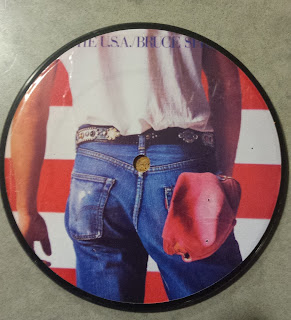
And, that's it. We've reached the end of Counting On A Package Deal until I get any more albums. But what's that you say? What does the record look like? Is it just another red circle? Well, you asked, and I shall deliver:

Remember, you asked.
Want to start your own record collection? Buy it on Amazon!
Past installments:
Greetings from Asbury Park
The Wild The Innocent & The E Street Shuffle
Born To Run
Darkness on the Edge of Town
The River
Born In The USA is easily Springsteen's second most famous album cover. This photo by Annie Leibovitz was destined to become iconic, and it seems like the Springsteen album design department knew it, because check out the back of the record:
Yup, just the same image again. I mean, come on fellas. That's just too much butt. It's the first, and as far as I know, only time that the front and back of an album have been completely identical. It makes me wistful for The River's horror show photograph.
The inside sleeve isn't as good as The River's was, but that was a tough one to top. However, for the first time, each individual E Street Band member gets their own spotlight photo, with the largest photos going to Clarence and, surprisingly, Garry Tallent. On the reverse of the sleeve, we get an in-color photo of Bruce - the largest color photo showing Bruce's face since Darkness. This would've been perfect for the back cover!
And there's a lyrics sheet. These are fine. Can't really say much about these.
And, that's it. We've reached the end of Counting On A Package Deal until I get any more albums. But what's that you say? What does the record look like? Is it just another red circle? Well, you asked, and I shall deliver:
Remember, you asked.
Want to start your own record collection? Buy it on Amazon!
Past installments:
Greetings from Asbury Park
The Wild The Innocent & The E Street Shuffle
Born To Run
Darkness on the Edge of Town
The River
Monday, June 2, 2014
Song Spotlight - "Born In The U.S.A."
Key Live Performance
Well, here we are folks, with the song that started it all. And, as with most Bruce songs, it is difficult to find just one "key" live performance. However, I've decided to spotlight one performance from the not-to-distant past. For the last 30 years, "Born In The U.S.A." has had quite a history, from being played too much, then being banished from all live shows, then to showing up only in more somber arrangements. Now, it seems the song is getting its proper due: it has been played at roughly a third of his shows this year. Seeing how this song was ranked 33rd on the top 100 Springsteen songs, I feel that's an appropriate amount of play. It is good to see that, after 30 years, that Bruce can still perform with the same raw passion that inspired the song.
Key Lyrics
"Had a brother at Khe Sahn
Fighting off the Viet Cong
They're still there he's all gone.
He had a woman he loved in Saigon
I got a picture of him in her arms now."
I always enjoyed the slant rhyming that is used throughout the song. It's subtle but consistent; from the opening rhyme of "town" with "ground" to finishing with "road" and "go". I may be reading too much into it (but god knows I wouldn't be the first to do that with this song), but the slant rhyming could be seen as trying to fit things together that don't quite work, which is how the Vietnam soldiers would feel returning to their home lives.
The spotlighted lyrics above are the closest thing that this songs has to a "bridge" section. All the verses until this point were written with two sets of couplets, but here, lines begin to disappear. The first part misses one line, and the next section removes yet another. By shortening the verses, Bruce heightens the drama of the song. At first listen, the "missing" lines may create curiosity to go back and listen to the song again. On further listens, we truly realize the emotional weight being carried here, as the "missing" lines aren't missing at all, but are moments of silence.
Overall
While it may not be Springsteen's best song, "Born In The U.S.A." is easily his most famous song. It has been discussed and dissected from every possible angle (heck, there's even a delightful spoken word version of it by Glenn Beck). Personally, it's a song that I "re-discover" every few years; most of the time, I never want to listen it, but every once in a while, it'll come up on my iPod and realize how fantastic it is. The lyrics are powerful enough to work with slower versions and not sound corny. The music, admittedly, sounds incredibly 80s with the preeminent synthesizer, but the hook is catchy enough to keep the song stuck in your head. While it's unfortunate that "Born In The U.S.A." may be the only Springsteen song many people can name, it is still a good representation of the themes of Springsteen's music.
Well, here we are folks, with the song that started it all. And, as with most Bruce songs, it is difficult to find just one "key" live performance. However, I've decided to spotlight one performance from the not-to-distant past. For the last 30 years, "Born In The U.S.A." has had quite a history, from being played too much, then being banished from all live shows, then to showing up only in more somber arrangements. Now, it seems the song is getting its proper due: it has been played at roughly a third of his shows this year. Seeing how this song was ranked 33rd on the top 100 Springsteen songs, I feel that's an appropriate amount of play. It is good to see that, after 30 years, that Bruce can still perform with the same raw passion that inspired the song.
Key Lyrics
"Had a brother at Khe Sahn
Fighting off the Viet Cong
They're still there he's all gone.
He had a woman he loved in Saigon
I got a picture of him in her arms now."
I always enjoyed the slant rhyming that is used throughout the song. It's subtle but consistent; from the opening rhyme of "town" with "ground" to finishing with "road" and "go". I may be reading too much into it (but god knows I wouldn't be the first to do that with this song), but the slant rhyming could be seen as trying to fit things together that don't quite work, which is how the Vietnam soldiers would feel returning to their home lives.
The spotlighted lyrics above are the closest thing that this songs has to a "bridge" section. All the verses until this point were written with two sets of couplets, but here, lines begin to disappear. The first part misses one line, and the next section removes yet another. By shortening the verses, Bruce heightens the drama of the song. At first listen, the "missing" lines may create curiosity to go back and listen to the song again. On further listens, we truly realize the emotional weight being carried here, as the "missing" lines aren't missing at all, but are moments of silence.
Overall
While it may not be Springsteen's best song, "Born In The U.S.A." is easily his most famous song. It has been discussed and dissected from every possible angle (heck, there's even a delightful spoken word version of it by Glenn Beck). Personally, it's a song that I "re-discover" every few years; most of the time, I never want to listen it, but every once in a while, it'll come up on my iPod and realize how fantastic it is. The lyrics are powerful enough to work with slower versions and not sound corny. The music, admittedly, sounds incredibly 80s with the preeminent synthesizer, but the hook is catchy enough to keep the song stuck in your head. While it's unfortunate that "Born In The U.S.A." may be the only Springsteen song many people can name, it is still a good representation of the themes of Springsteen's music.
Tuesday, April 22, 2014
How Do I Begin Again? – An album review of The Rising

“How do I begin again?”
– My City of Ruins
The above question defines The Rising. And its query is two-fold. On the one hand, The Rising is explicitly a response to 9/11. On the other, it marks a new stage in Bruce Springsteen's career. What seemed like the beginning of his third act, has since become an extension of the second act in a career even more prolific than anyone would have imagined back when Born in the U.S.A. cemented him as a cultural icon.
Prior to the release of The Rising, Bruce had managed to shake off his 1990s "Who am I" malaise with the release of The Ghost of Tom Joad – an album which won him critical, but not commercial, acclaim. Having reaffirmed his artistic credibility, Bruce then won back the masses by resurrecting The E Street Band for a series of nostalgic concerts. But the true test would be producing an original album with The E Street Band, their first in 18 years. Everything was on the line with The Rising. Would Bruce reassert his relevance? Or would he fade away?
Fortunately, the album was a massive success, debuting at number one on the Billboard 200 chart, drawing rave reviews, and bringing home three Grammys.
I’ve mentioned before that The Rising is my favorite Springsteen album – and by extension, my favorite album of all time. It holds a special place in my heart, and trying to look back at the album without the patina of nostalgia is futile. As such, the following review leaves out much of the praise and ardent emotion I feel for the album. I attempted to look at it more analytically, and tried to wrestle with its themes and structure. I’m not sure how successful I was, but I tried to tackle each song both on its own and as a piece of a larger work. It was a stirring experience, and the album holds as my favorite.
Like any work of art, it’s not without its weaknesses. I find the track order a bit odd at times, and I think it could have benefitted from some restructuring. For example, “Waitin' on a Sunny Day” and “Countin' on a Miracle” feel like variations on a theme. Yet they are separated by a single track, “Nothing Man”. I think this pair of songs would have benefited from either having greater distance on the album, or appearing back-to-back as if to illustrate a progression from passive to active.
After you've been to a live show, it’s nearly impossible to distance the album version of “Waitin' on a Sunny Day” from the sing-along spectacle it has become in concert. Which is too bad because it’s still a good song in its own right!
While “Waitin' on a Sunny Day” has taken on a more lightweight feel over the years, “Mary's Place” has taken on increased poignancy for me. When the album came out I originally tended to dismiss “Mary’s Place” as rather simple. But in the twelve years in between, its complexities have revealed themselves to me as the quiet pain of someone in grief trying to emerge from depression and daring to live again. While many of the songs feel immediate and focused on the here and now of 2001, songs like “Mary’s Place” round out the album's meditation on 9/11 by considering its lasting effects further on in time. It’s the song that brings me closest to tears (“Tell me how do you live broken hearted?”). It can make for an emotional wallop, as it’s followed by the album's more traditional tearjerker, “You're Missing" ("I got too much room in my bed").
Meanwhile, “Worlds Apart” and “Let’s Be Friends (Skin to Skin)” come off as a pair of good intentioned, albeit simple, odes to racial equality and acceptance. The minimalist “Paradise” would seem unremarkable, unless consumed as the natural ending of the album’s larger narrative. Within this context, “My City of Ruins” appears as a bonus track – a fantastic, malleable song that has adopted multiple identities over the years, serving as a beacon of hope for Asbury Park, 9/11, and Hurricane Sandy, respectively.
In many ways, The Rising is one of Bruce's least angry albums, which catches you off guard given the subject matter. There may be some pent up rage in “The Fuse” and “Empty Sky”, but by and large this is an album of solemn reflection. Which is something I really admire: Bruce's discretion and tact. He invokes 9/11 through direct imagery in “Empty Sky” and “Into the Fire”, but there aren't any songs about planes or Al Qaeda.
All that and I haven’t even talked about the album’s title track, or my favorite song on the album, “Lonesome Day”. My experience with both songs was initially formed by their music videos that made the rounds frequently on TV. “The Rising” grabbed my attention with the electric MTV Video Music Awards live performance that served as its music video, but it was “Lonesome Day” with Bruce soul searching on the Jersey Shore that got me off the couch and into the record store. It’s hard for me to listen to either song without instantly descending into the hard rocking head nodding and emotional lip synching that I engaged in as a 17-year-old. What can I say, I love everything about both of these songs.
If it hadn't been for The Rising, there would be no LegendsofSpringsteen.com. If the album had fizzled, Bruce would not have enjoyed the renaissance he's currently experiencing and he would not have ushered in a new generation of Springsteen fans to the degree that he has. Even if The Rising isn’t your favorite album, it served as the gateway for a large number of the millennial generation into a profound relationship with The Boss.
Tell me, how do we get this thing started?
Friday, December 27, 2013
Great Moments in Springsteen TV History: WWF Wrestling Superstars
This isn't the first time I've written about "Born In The USA" as an entrance theme. Nor is it the first time I've written about professional wrestling on this blog. But back in the early to mid to eighties, when pro wrestling was gaining incredible popularity nationwide, as the World Wrestling Federation (WWF, now World Wrestling Entertainment) continued to expand nationwide, it wasn't uncommon for wrestlers to enter the ring songs by popular rock stars of the day. But as cable TV became more and more prevalent, and musicians started to realize that they weren't getting any royalties, that was the ended of using copyrighted music without permission.
However before that time came, there was a popular tag team named the US Express, made up of Barry Windham and Mike Rotundo. Two brothers-in-law, represented as "All-American" athletes, but not NCAA "All-American" athletes. They represented hard work, dedication, and teamwork. What better entrance theme for them then Bruce Springsteen's "Born In The USA"? As with a lot of people in the 1980's, including President Ronald Reagan, the actual lyrics and meaning of the song were overlooked due to it's catchy chorus and anthem-like introduction. In the above match, watch how many fans are singing along with the music as they take to the ring. Even moreso, after the match, when the US Express is celebrating winning the coveted WWF Tag Team titles, the music fits the atmosphere perfectly. Unfortunately now, when WWE re-releases old US Express matches on DVD sets, "Born In The USA" is dubbed over with a generic knockoff to avoid paying for the rights to use it, as seen here. It just doesn't seem the same without Bruce.
Interesting trivia fact: When WWF stopped using copyrighted music they replaced "Born In The USA" with a song that was written by a songwriter they hired to create new entrance music for everyone. The song he wrote for The US Express was "I Am A Real American", but Barry Windham quit WWF a few weeks later and "I Am A Real American" was given to wrestling phenomenon Hulk Hogan. The song would become a major part in Hogan's identity and help propel him from beyond just pro wrestling fame and into a pop culture superstar. However if you are not a fan of wrestling or Bruce Springsteen, this is not interesting trivia at all. I apologize.
Friday, June 28, 2013
Video Spotlight: "Banned In The USA" (2 Live Crew)
Author's Note: The below post reflects my opinions alone, and not necessarily the other contributors to this blog, or www.legendsofspringsteen.com as a whole. Thank you.
Last week, rapper Lil Wayne made headlines when he was shooting a video for his new song "God Bless America" and during the shoot the American flag fell to the floor and Lil Wayne stepped on it. He later claimed it was just an accident, but after watching the video and hearing the context of the satirical nature of the lyrics, I don't believe him. This once again started a debate in this country on free speech. Which reminded me of the above video.
For those who need a quick history lesson, in the late 80's 2 Live Crew released an album called As Nasty As They Wanna Be, featuring their big hit "Me So Horny". The album's content was deemed so offensive that it was deemed obscene and illegal to sell in certain counties in Florida(where the trial was held). 2 Live Crew were arrested when they attempted to perform the songs at a local strip club, and record store owners were arrested for selling the album. Eventually the verdict was overturned, but 2 Live Crew responded to what they deemed as blatant slap in the face of the First Amendment with "Banned In The USA", featuring interpolation of Bruce Springsteen's iconic "Born In The USA", with The Boss's full consent.
Freedom of speech is one of those issues that everyone says they believe in, but few actually do. It's something that I have especially noticed in the past few years that has really disgusted me. Hypocrisy is on both sides of the aisle. Conservatives always want the freedom of speech to criticize President Obama, but are quick to point the finger of blame when liberals bash wars, or when secularists criticize religion. The left says they are all for freedom of artistic expression, but try being a comic and making a joke about rape, or using terms that certain groups find offensive. Even now Paula Deen is taking a merciless beating in the media for comments she made 30 years ago. How can we, as a country, say we believe in freedom of speech but turn against one another at the first chance when we hear something we don't agree with?
True freedom of speech, means defending people's right to say things, even when it offends you. Especially when it offends you, as a matter of fact. If you are offended by something, do not listen to it. But just because you do not want to listen to it, does not mean that nobody is allowed to listen to it. There is no constitutional amendment that says we are free from being offended. Personally I think Lil Wayne is a jerk for that video. But he has the right to do it, and I will exercise my freedom by not purchasing his albums (not like I was going to anyway, though). I'm reminded of the late, great comic Bill Hicks' who did a bit on people burning the flag. I'm paraphrasing here but the joke was basically that soldiers didn't die defending the flag. The flag is a piece of cloth, they died defending what the flag represents. Which is freedom of expression, such as burning the American flag. While I personally would never burn a flag, and would attempt to stop anyone I see doing it, I don't think it should be a criminal offense. And apparently the Supreme Court of the United States agrees with me on this one. Also, the idea of an album being so obscene that it's illegal is ridiculous.
I've never seen Bruce try to silence his critics who have bashed him for his liberal views so I have to believe he agrees with me on this point of view. He's never gone so far as burning a flag, and I can't imagine he ever would. However he was certainly a vocal critic of Presidents Reagan and Bush (both), and has championed many liberal causes. He has the right to do so, but has also welcomed those who criticize his points of view. I find that admirable.
Tuesday, April 9, 2013
Lyrics Spotlight - Darlington County
Seen Wayne handcuffed to the bumper of a state trooper's Ford”
- Darlington County, Born in the U.S.A.
I have been reading a lot of Raymond Carver’s short stories lately and I feel that “Darling County” bears strong similarities to a Carver story. Carver’s writing style is brusque and to the point but paradoxically full of vivid detail. Many of the stories have an unexpected turn or twist in the end that reveals the ugly side of human behavior without rationalizing or explaining it.
This description seems like a natural connection to the Nebraska album but I actually think “Darlington County” is the closest in style to a Carver short story. The song begins happily enough with its tale of youthful abandon and the seemingly wide-open possibilities in front of the lead characters. As it progresses, the intentions of the characters appear more lascivious and less innocent. In the final line, the narrator drives out of Darlington County with the image of his buddy handcuffed to a cop car in his rear view mirror. We don't know what happened or why it happened but much like you find in a Carver story, something serious happened and it can't be explained, but it can be interpreted.
Tuesday, April 2, 2013
Hold Tight To Your Anger - Why People Hate Springsteen

Inspired by the discussion over at Reddit, it is time for us to take a short aside from our normal Springsteen lovefest and enter the dark world of the Springsteen haters. When running into someone who doesn't like the Boss, the editors here at Legends of Springsteen react like Jerry Seinfeld's mother: "He's a wonderful, wondeful man! How could anyone not like him?" However, I feel it is important to understand why they dislike Springsteen, as it could help us understand our own fandom more. I've assembled the five most common critiques I've heard of Springsteen, and ranked them by how important I personally see them in affecting someone's opinion of a musical artist. That being said, let's start with a doozy:
5. His Politics: Many people may argue that this should be higher on the list, perhaps even number one. From his ardent support of Obama and Kerry, to "41 Shots", to the "phoniness" of a millionaire making millions while singing about the poor and downtrodden, there's a lot there to angry up the blood of conservatives (just sit down for a beer or two with our contributor OB and you'll hear all about it). However, I've ranked this fifth for a multitude of reasons.
First, the process of become a fan of a musician doesn't start usually with finding out their political identity. You hear some songs, then you hear some albums, then you find out more about their life, then you create a fawning internet blog about them, etc. There's many bands I listen to now where I couldn't name a single member of the group, let alone know their political leanings. There are some outliers where you can know their politics before even listening to their music (i.e. Lady Gaga), but that is generally not the case.
Second, aside from a few tracks in Wrecking Ball, Bruce's political causes were positive, promoting empathy rather than assigning blame. "Born In The U.S.A." and "41 Shots" were not calls to condemn those who sent our troops to Vietnam or the New York Police Department, but rather songs to shed a light and sympathize with the struggles of the returning veterans and the poor of the inner city.
Finally, whether you agree with his politics or not, I think you have to show him some respect for being honest with his opinions in today's heated political age. Many celebrities choose not to make any bold statements, because, as Michael Jordan once said, "Republicans buy sneakers, too." While I don't think anybody has an obligation to use their celebrity to promote a cause, I find it more respectable than dodging the issues and remaining a blank slate.
As someone who is fairly liberal, I am a fan of many artists and performers who lean to the right, such as Adam Carolla, Frank Miller, and Norm MacDonald. I've been able to enjoy their work while not letting their specific opinion cloud my judgement (especially if the work has nothing to do with their politics). I also think it is interesting to listen to someone with a different world view than mine - the world would be pretty boring looked as something the same way. Just be sure your music is catchy, or I won't give you the time of day.
4. He's An Old White Guy: This applies more for those "kids today", but perhaps can be applied to multiple generations. Bruce's act is all no-nonsense - he gets up there, and blasts out his music. There aren't any props, no explosions, no wacky outfits, etc. And, because of that, he seems "lame".
Mind you, this isn't to criticize other musicians who rely on an image - that's been a staple of pop music forever. However, they own the "cool" factor today, just as Bruce and his leather jacket did in the 70s.
I assume those Bruce-haters that use this excuse are on the younger side, so there's still hope for them. On a personal note, I'll share with you a dark secret that I"ve kept hidden in my past: in high school, I hated the Beatles. It was just old, campy garbage to me. Slowly, I started to like their later, more experiment stuff, but still didn't like their early pop songs until I was perhaps 19 or 20. It will take everyone time to develop their true musical taste, where they aren't concerned with how liking a particular musician will make you seem to your peers. Which segues nicely into reason number 3.....
3. Springsteen Fans: Imagine going to a Justin Bieber show, and being surrounded by thousands of screaming preteen girls. Now, I have nothing against preteen girls, but it sounds like a scene I want no part of. Now, instead of teenage girls, you are surrounded by middle-aged white dudes. And then imagine that those middle-aged white dudes have the exact same amount of unbridled enthusiasm when Bruce comes on stage as those little girls have for Bieber. While it might sound great for you, as a Springsteen fan, it may sound like a nightmare scenario for others.
It's a tough stereotype to battle. Every time I go to a concert, I feel like I can count the number of black people with one hand - and those are mostly the ones in the band. So, I don't disagree with the fact that middle-aged white guys have built Springsteen's mansion. However, judging an artist by the people who enjoy them relates strongly to my previous point, and is a fairly immature attitude to have. If you enjoy a certain type of music, who cares who else does? It is also a self-fulfilling prophecy: you aren't enjoying Springsteen because you don't see people like you enjoying Springsteen.
2. His Pop Songs: When I think of musicians I don't really care for, it is only because of the limited amount of songs I've heard. I'm not going to scour through all their albums and judge their entire body of work. And, frankly, who has time for that?
In regards to Springsteen haters, it is probably because they have only heard a few of Springsteen's biggest hit songs. "Glory Days" and "Dancing In The Dark" aren't in the top 60 of Springsteen songs as chosen by the fans, yet they are probably two of Springsteen's most widely known songs in the general populace. It is not unreasonable to assume that these type of songs turned someone off from the Boss. If you hate Springsteen based on limited knowledge, I'd implore you to explore this blog: I guarantee you will find something you like.
1. His Voice: Well, we've come to the part of the post that I really can't defend. The previous four excuses I've chalked up to immaturity, lack of knowledge, and general uptightness. But Bruce's voice clearly has people who will hate it no matter what. As one comedian said, "Springsteen has the voice that everyone uses when they call in sick for work." It's a funny line, and absolutely right. This is just a matter of taste, and if someone has gotten past his politics, his fans, and his pop songs, and STILL hates Springsteen, you just have to shrug your shoulders and move on. Not everyone has to love Springsteen; it is their loss, not ours. To quote Wayne's World: "Led Zeppelin didn't write tunes everybody liked. They left that to the Bee Gees."
Friday, March 1, 2013
Lyrics Spotlight - Ain't Got You
“I got a pound of caviar sitting home on ice
I got a fancy foreign car that rides like paradise
I got a hundred pretty women knockin' down my door
And folks wanna kiss me I ain't even seen before ”
- Ain't Got You, Tunnel of Love
At the end of a long working day, I go through a process I call "decompression", where I take about 10-15 minutes to relax and wash away the stresses of the day (which come more from the commute rather than the job). It's a three step process that involves 1. blasting music, 2. taking off nearly all my clothes, and 3. throwing myself face-first onto the couch. I understand this may be an unsettling image to some of our readers and is in no way essential to the rest of the post, but I'm offering it out there as a solution to cure one's post-work stress.
Anyway, during one of my decompression moments, "Ain't Got You" started playing. My girlfriend, who is a nascent Springsteen fan, takes notice, and asks if this was a cover song. I assured her it wasn't, but immediately went to Wikipedia to check. This minor interchange got me thinking about not only this song, but the way we interact with music today.
As a young Springsteen fan from the later 90s, my experience is completely different from those fans from the 70s and 80s, which is why "Ain't Got You" has fascinated me. Here was Bruce's first studio album since the chart-destroying Born In The U.S.A., and so much had changed in that time. Changes came not only from Bruce himself (being married, using less of the E Street Band, change in song subject matter), but in the way you, as a fan, consumed his music. In 1984, fans bought Bruce's album in vinyl, dropped the needle, and heard a pounding song about the struggles of thousands of Vietnam veterans. In 1987, fans were probably buying Bruce for the first time on compact discs, and immediately got a stripped-down bluesy number about a rich guy trying to win over a hottie. It must have been a crazy shock for Springsteen fans that, given my youth, I'll never be able to fully understand.
That being said, I've always listened to "Ain't Got You" outside of its historical context in Springsteen's career, and absolutely love it. The simple 1950s musical vibe completely works with the over-the-top riches lyrics. It even has a little bit of a touch of George Michael's "Faith", which was released at almost the same time. I spotlighted the above lyrics, as they remind me the most of Joe Walsh's "Life's Been Good". There was a podcast where Chuck Klosterman interviewed Joe Walsh, and asked him how much of "Life's Been Good" was actually true. If I ever had the chance to sit down with Bruce, I'd love to hear what about "Ain't Got You" was actually true. I really can't picture Bruce driving a foreign car, and have a tougher time imagining him in possession of a pound of caviar at any point in his life.
Friday, November 30, 2012
Lost Song- "County Fair"
Another song where I simply shake my head and say "How has song not been released!?!?" At least it's not a totally hidden song, as Bruce has played this rarity live in concert, albeit very few and far between. This song was an unreleased track from Born In The USA, which just might be my favorite time for Bruce songwriting (depending on what kind of mood I'm in).
I came across this song on E Street Radio, and the imagery in this song is fantastic. By the time the chorus kicked in, I immediately had images of going to local carnivals as a kid and going to the NY State Fair with my grandparents. There's not much I can say about this other then "just listen". I'm really hoping that next year will see the release of something special for Born In The USA's 30th anniversary. Between this song and "Unsatisfied Heart", this period of Bruce's songwriting really does deserve the recognition.
Friday, September 14, 2012
Book Review - Glory Days by Dave Marsh

Dave Marsh's two Bruce Springsteen biographies – Born to Run and Glory Days – are widely considered the definitive books about The Boss. With unparalleled access to Bruce and his camp, it would be hard for them not to be. If anything, Marsh has been criticized for hero worship. But you won't find any such criticisms on a blog called Legends of Springsteen. Hero worship or not, Marsh’s detailed, engaging and affectionate writing deserves credit on its own merit.
Glory Days picks up where Born to Run leaves off and covers Bruce's career from The River through the release of Live: 1975-1985. One of the highlights here is a finely detailed account of Springsteen creating the Nebraska album. The picture of Bruce alone in his New Jersey home writing and recording the solo album may seem like familiar territory in Bruce folklore. However, the level of insight to the album's production and the marketing approach offers an engrossing account of the album’s unorthodox production.
Another section I found particularly enlightening was the post-Born in the U.S.A. success. Marsh gives a grand account that represents the sheer enormity of the album's popularity. I was intrigued to learn about the radio / dance remixes of "Born in the U.S.A." and "Dancing in the Dark" by Arthur Baker. I didn't even know these versions existed before. It's interesting to listen to them now - although both are unremarkable apart from their novelty.
The book concludes with a great promotional effort for the Live: 1975-85 album. I had never given the album much thought before, figuring that I have so many live songs already but after reading about the considerable work that Bruce and record producer Jon Landau put into the track selection and order, I'm very eager to pick up a copy. Marsh includes a quote from Landau about the project that we should all envy: "It was an enormous amount of work and it was easy as hell."
Glory Days is full of beguiling anecdotes that will have Bruce fans enraptured for page upon page. My personal favorite involves Bruce going to see a movie by himself in Denver and ending up meeting a teenage fan who invites him back to his house for dinner with his parents. It's tempting to suspect such stories to be apocryphal but it's much more fun to believe that Bruce really is that down to earth.
Returning to the hero worship claim, there isn't much critical here beyond a harsh ribbing of "Downbound Train". Throughout the book, you kind of keep waiting for some sort of failure to creep in but it's really all about success. I would be fascinated to read Marsh's take on 1987 through 1996 in contrast. In 2003 Marsh released Two Hearts, the Story which combined abridged versions of Born to Run and Glory Days and included a new addendum on The Rising. I haven’t had the opportunity to read it myself but from what I understand it doesn’t delve into the less revered period of Bruce’s career.
I picked up my second hand copy of Glory Days for $2.00 at a Housing Works in New York City. What a steal! Every Springsteen fan should read this book. If you aren't lucky enough to find a copy in a secondhand store, it's still worth the money on Amazon Market Place. Just be sure that you have your iPod within reach while you're reading.
Friday, September 7, 2012
First Drafts - Born in the U.S.A.
The story behind this version of "Born in the U.S.A." is pretty well known by most Bruce Springsteen aficionados. But, for those who may be hearing this somber, acoustic version of the song for the first time, it goes like this: this track was originally written for the Nebraska album. However, his producer, Jon Landau, loved the lyrics and heard the potential for a hit. It was reworked with the full band, and became the oft-misinterpreted yet iconic anthem it is today.
Did they make the right decision? Economically, the answer is a resounding "yes." It put Springsteen on the map, and moved millions of records. But, did taking such hard lyrics and wrapping them in fist-pumping pop chords negate the message of the song? It can be argued that the true nature of the song is most effectively communicated in the somber Nebraska sound.
Personally, I feel that Landau and Springsteen made the right decision. The pop nature of the song, as well as the ensuing controversy regarding the song's message, helped make even more people aware of the plight of Vietnam veterans. You can only spread your ideas if people are listening to them, and by making the track more mainstream, he created more fans willing to explore his music and its themes. It was also a time where social causes were being promoted through pop songs, such as "Sunday Bloody Sunday" and "Do They Know It's Christmas?", so it wasn't unprecedented, and this kind of music helped influence generations to come.
Which version do you prefer? Let us know in the comments.
Friday, July 13, 2012
Roy Nelson: Born In The USA
It may come as shock to know that we actually do have hobbies outside of Bruce Springsteen. I swear. Not many, but hey at least we have some variety. One of those hobbies for me is the Ultimate Fighting Championship, or UFC.
I am a huge fan of almost every sport, and have a tremendous amount of respect for anyone who can compete at the top level of their respected sport. But UFC fighters take it that extra mile. Some people have called it barbaric, but I doubt those people have ever watched an actual match. To watch 2 fighters trade strikes, look for takedowns and basically play mental chess with one another is truly an art. These are, in my opinion, the best athletes in the world. They're conditioning, both mental and physical, is second to none.
...And then there's Roy Nelson. Remember all those things I just said about them being superior athletes and in phenomenal condition? Yeah, that doesn't apply to Roy "Big Country" Nelson. Standing at 6 foot tall, and 254 lbs (and at least 20 of the lbs comes from his beard and mullet alone), Roy Nelson does not have any style or fineness. He simply fights. He's taken some of the worst beatings the UFC has ever seen, and also dished them out.
So why am I writing about Roy Nelson? Because Roy Nelson's entrance song is none other than "Born In The USA". It really might be the most fitting entrance music I've ever heard. Even though the song is anti-war, government-questioning song lyrically, most people just know it for its thematic intro, and anthem chorus. And that's basically what Roy Nelson is. No fuss, no frills, just a "Born In The USA" fighter, who's ready to kick some ass. Is he the best fighter out there? Absolutely not. Does he always put on a great show? Hell yes.
and...
I am a huge fan of almost every sport, and have a tremendous amount of respect for anyone who can compete at the top level of their respected sport. But UFC fighters take it that extra mile. Some people have called it barbaric, but I doubt those people have ever watched an actual match. To watch 2 fighters trade strikes, look for takedowns and basically play mental chess with one another is truly an art. These are, in my opinion, the best athletes in the world. They're conditioning, both mental and physical, is second to none.
...And then there's Roy Nelson. Remember all those things I just said about them being superior athletes and in phenomenal condition? Yeah, that doesn't apply to Roy "Big Country" Nelson. Standing at 6 foot tall, and 254 lbs (and at least 20 of the lbs comes from his beard and mullet alone), Roy Nelson does not have any style or fineness. He simply fights. He's taken some of the worst beatings the UFC has ever seen, and also dished them out.
So why am I writing about Roy Nelson? Because Roy Nelson's entrance song is none other than "Born In The USA". It really might be the most fitting entrance music I've ever heard. Even though the song is anti-war, government-questioning song lyrically, most people just know it for its thematic intro, and anthem chorus. And that's basically what Roy Nelson is. No fuss, no frills, just a "Born In The USA" fighter, who's ready to kick some ass. Is he the best fighter out there? Absolutely not. Does he always put on a great show? Hell yes.
and...
Friday, May 18, 2012
Lost Songs - The Klansman
Thank goodness for E Street Radio. The Sirius station really can’t be praised enough. In addition to giving us round the clock variety and live concerts, it exposes us to Springsteen songs we may never have heard otherwise. And as we’ve expressed before, Bruce has a seemingly never ending treasure trove of lost songs.
A few weeks ago, I was fortunate enough to hear “The Klansman.” The audio quality on the version on YouTube is not the clearest, but it’s the best we’ve got for on demand listening. Like so many of Bruce’s songs, it’s pretty hard to understand what he’s signing the first few times you listen, but the more attention you give it, the more you'll be rewarded.
One of the many outtakes from the Born in the USA sessions (along with “Unsatisfied Heart”), “The Klansman” tells the story of a young boy being introduced to the Ku Klux Klan. A blog called Catholic Sensibility describes it as a song about a young boy being seduced by the allure of the Klan. But I don’t think it’s as clear cut as that. I think the song leaves enough room to view the narrator as an unwilling participant who witnesses his family and neighbors corrupted by the evils of the Klan and is unable to do anything other than cast a blind eye.
The lyrics are succinct, with no resemblance of a chorus, but they’re powerful and the picture it paints is frighteningly vivid. The music also has a haunting, yet captivating sound that is hard to mimic, but also hard to shake.
Word of the trouble spread around
One day a man came to my town
I was in the kitchen when my Pa let him in
He shook my hand, said, "The Klan's your friend"
Was a meetin' at Lyle Stanton's house
On the Jefferson Highway
Some, they did not listen
Some did not turn away
Said, "When the holy rain of fire
Comes tumblin' from above
It'll be a Klansman
Who stands for the land he loves"
Look away, look away now
I was ten years old when my Pa said,
"Son, some day you will see
When you grow to wear the robes
Like your brother and me
When the war between the races
Leaves us in a fiery dream
It'll be a Klansman
Who will wipe this country clean
This, son, is my dream".
A few weeks ago, I was fortunate enough to hear “The Klansman.” The audio quality on the version on YouTube is not the clearest, but it’s the best we’ve got for on demand listening. Like so many of Bruce’s songs, it’s pretty hard to understand what he’s signing the first few times you listen, but the more attention you give it, the more you'll be rewarded.
One of the many outtakes from the Born in the USA sessions (along with “Unsatisfied Heart”), “The Klansman” tells the story of a young boy being introduced to the Ku Klux Klan. A blog called Catholic Sensibility describes it as a song about a young boy being seduced by the allure of the Klan. But I don’t think it’s as clear cut as that. I think the song leaves enough room to view the narrator as an unwilling participant who witnesses his family and neighbors corrupted by the evils of the Klan and is unable to do anything other than cast a blind eye.
The lyrics are succinct, with no resemblance of a chorus, but they’re powerful and the picture it paints is frighteningly vivid. The music also has a haunting, yet captivating sound that is hard to mimic, but also hard to shake.
Word of the trouble spread around
One day a man came to my town
I was in the kitchen when my Pa let him in
He shook my hand, said, "The Klan's your friend"
Was a meetin' at Lyle Stanton's house
On the Jefferson Highway
Some, they did not listen
Some did not turn away
Said, "When the holy rain of fire
Comes tumblin' from above
It'll be a Klansman
Who stands for the land he loves"
Look away, look away now
I was ten years old when my Pa said,
"Son, some day you will see
When you grow to wear the robes
Like your brother and me
When the war between the races
Leaves us in a fiery dream
It'll be a Klansman
Who will wipe this country clean
This, son, is my dream".
Wednesday, March 14, 2012
Springsteen Lyrics of the Week - Glory Days
“Think I’m going down to the well tonight
And I’m gonna drink till I get my fill”
- Glory Days, Born in the U.S.A.
In one of Bruce’s songs where the narrator is more self-aware than usual, this line always strikes me as the pathetic comment of a sad sack whose life is passing him by. Ironically, the lyrics have also been adopted as a rally cry for countless drunkards on Friday nights for the past 20 years.
Like so many of Bruce’s songs, the upbeat tone and fast rhythm mask the downbeat lyrics and people frequently misinterpret this song as a fond remembrance of the good ol’ teenage days when it’s really about failing to seize the day because you’re too busy thinking about the past with rosy-tinted glasses.
Bruce does his bit to foster the misappropriation with his “Come on boys, keep it rockin’ now” riffing as the music fades out. Which raises a question, for another post, does Bruce make his songs too easy to misinterpret?
And I’m gonna drink till I get my fill”
- Glory Days, Born in the U.S.A.
In one of Bruce’s songs where the narrator is more self-aware than usual, this line always strikes me as the pathetic comment of a sad sack whose life is passing him by. Ironically, the lyrics have also been adopted as a rally cry for countless drunkards on Friday nights for the past 20 years.
Like so many of Bruce’s songs, the upbeat tone and fast rhythm mask the downbeat lyrics and people frequently misinterpret this song as a fond remembrance of the good ol’ teenage days when it’s really about failing to seize the day because you’re too busy thinking about the past with rosy-tinted glasses.
Bruce does his bit to foster the misappropriation with his “Come on boys, keep it rockin’ now” riffing as the music fades out. Which raises a question, for another post, does Bruce make his songs too easy to misinterpret?
Wednesday, February 29, 2012
Springsteen Lyrics of the Week - Car Wash
I work at the Astrowash on Sunset and Vine”
- Car Wash, Tracks (Disc 3)
The narrator in this song, Catherine, views her identity as tied to her profession and is unable to distinguish between the two. She dreams of being a professional singer instead of her current job at a car wash and can't imagine doing both simultaneously. She complains about her boss and views work as “doing her time.” She’s stuck in a dead end job and doesn’t have the drive to change her lot in life. It’s familiar territory for Bruce Springsteen. But what is so surprising about “Car Wash” is that Bruce chooses to sing from the perspective of a woman.
It’s not unusual for Bruce to sing about a woman, as he does in “Queen of the Supermarket” for example, but it’s hard to think of other cases where Bruce sings from the perspective of a woman. He does it for a verse in “American Skin (41 Shots),” but in that case he’s quoting rather than inhabiting character. Gotham Gazette notes that “Into the Fire” is sung from the perspective of a fireman’s widow and while the song suggests its from the perspective of a woman, the gender is not made explicit as is the case with “Car Wash.”
Gender-reversal between performer and narrator is a rare occurrence in general, especially in pop music. But it feels extra startling to hear a first-person female character coming from Bruce's ragged baritone. Perhaps the Bruce of “Hungry Heart” would be less jarring but there's no attempt to neuter his gender here (besides, we’re still not convinced Bruce actually sings “Hungry Heart.”)
“Car Wash” was originally written for Born in the U.S.A. As with several Bruce songs from the era, it's possible he originally wrote it for a female performer like he did with “Because the Night” and “Fire.” But even if that was the case, he could have easily swapped the gender when he performed it himself. Instead, he sings unambiguously from the perspective of a woman. Why does Bruce do that? Perhaps it's a bid for equal opportunity. Perhaps it's to change routine. Perhaps there’s something deeper.
Personally, I find “Car Wash” to be a very moving character study and feel like Bruce really does get in the head of his character, Catherine. Does the gender-reversal have an affect on your appreciation of the song? Would it have been too experimental for Bruce to put it on an original album? Are there other notable songs where the gender of the singer doesn’t align with the narrator?
Friday, February 24, 2012
Springsteen Reflections: Born in the U.S.A.
Legends of Springsteen is delighted to present a guest post from James Layman – lawyer in training, friend of the blog, and North Jersey native. Here, James reflects on a defining experience with Born in the U.S.A.

Anyone familiar with the 1990 Dodge Dynasty can share with its hallmark characteristic: the engine was too powerful for the chassis, the handling, and indeed, the entire car. Any significant pressure on the gas would produce a vibrato so commanding that the steering wheel would shake. By the time you hit 80, the entire frame was trembling, threatening to self-destruct into a thousand smoldering pieces on the freeway.
I drove one in the spring of 2004, delivering pizza in North Jersey. I was seventeen.
While iTunes and digital downloads revolutionized music in the latter part of the last decade, something was lost in the subversion. Single hits now exist on their own, outside the context of an album, like single chapters in a book. Digital downloads may have ushered in the death of the narrative, so I feel privileged to have been part of the last generation of listeners to appreciate an album as a story. And “back then,” we all had a story - something encapsulating an age, a season, a mood, or a place. A freeze frame of a halcyon era we could never return to, but never really escape.
In the spring of 2004, my story was Born in the U.S.A. The album was a 12-track epic about making peace with the love, loss, disillusionment, and despair of a stark American era. I’ll admit I couldn’t relate to all of Springsteen’s characters - the plight of a Vietnam Veteran returning home or the deterioration of a young man’s hometown were foreign to me, especially at seventeen. But beneath Springsteen’s earnest and painfully wrought portrait of American life was the constant need to escape. Characters stayed awake at night talking about “getting out.” They drank too much, chased old flames, and raised hell in Darlington County - always dreaming of an open highway to greener pastures somewhere far beyond. The theme wasn’t just definitive of Born in the U.S.A., but of Springsteen’s entire catalogue.
I used to get out of work sometime around midnight, and drive the Dynasty down my block to where it met Route 17, a highway that ran from East Rutherford up through New York State. I traced the road back to where it met the horizon, clinging to a romantic notion of where it might lead. I had four wheels beneath my feet, nowhere specific to go, and all the time in the world to get there.
Come graduation I left, like most of us did. Many to college, some to the military, and others to God knows where. At long last, honoring the relentless pursuit of our own stories and our own endless roads. It’s a natural part of growing up I suppose - rumbling forward with a purpose too big for your hometown and a heart too powerful for your body, into the great and wonderful beyond.
Wednesday, February 22, 2012
Quick Take - Shackled and Drawn
First off, let me start by saying that I absolutely love the idea of releasing a song per day. The album is going to get leaked anyway, at least this way Bruce has somewhat control over it, while still being able to build anticipation. [Editor’s Note: It pretty much got leaked anyway, but at least Bruce is sticking to it.]
“Shackled and Drawn” sounds like a leftover track from the Seeger Sessions album, and I mean that in a good way. While I don’t think it’s a great song, it’s certainly good and seems like it’ll be a really fun song to see performed live. Lots of clapping hands and stomping feet and a really easy chorus makes it all but a certainty that this song will be played regularly on the upcoming tour.
However, just because the chorus is simple doesn’t mean the lyrics aren’t relevant. The clear allusions to slavery and injustice are abundant. All previews of Wrecking Ball said this was Bruce’s most political and angry album to date, and so far it has met that expectation. The three songs released, in addition to the three that have been played live in the past, all seem to contain angry and politically motivated lyrics. In addition they have been ironically set to mostly upbeat, catchy tunes that can easily override the meaningful lyrics, reminiscent of “Born In The USA” being mistakenly categorized as a patriotic song upon its release. And I think that’s what Bruce is aiming for here. Get the song stuck in your head, sing it to yourself, and then realize just what the song means.
Friday, February 17, 2012
Great Moments in Springsteen Cinema History - Mission: Impossible - Ghost Protocol
Warning: Minor spoilers ahead!
If you haven't
seen the blockbuster Mission: Impossible - Ghost
Protocol by now, you missed out on one of the most thrilling
moments in cinema history. No, I'm not referring to the high-wire act
along the Burj Dubai, nor the thrilling Russian prison break, nor a
catfight between Paula Patton and Sabine Moreau. I speak, of course, of
this:

That's right, that is Tom Cruise rocking a Bruce Springsteen Born In The USA t-shirt. Ethan Hunt changes into this outfit after escaping from the Kremlin. He ditches his military disguise and dons this in order to appear as a common American tourist. That, my friends, is a brilliant disguise. While it is unclear whose choice it was to use this t-shirt (the internet has been sadly lacking on articles about Cruise using this shirt), I'd like to imagine that it is a silent tribute to Brian DePalma, director of the first Mission: Impossible movie and the "Dancing in the Dark" music video.
However, there is some intrigue surrounding the shirt's role in the movie. As Ethan Hunt escapes, he is caught in an explosion and ends up in a hospital....sans the t-shirt! Now, one may claim that the shirt could have been destroyed in the explosions, but it is revealed that the Russians found Ethan's military disguise. So what is the deal here? A minor continuity error? Or a secret Russian plot to find out the secrets of Bruce's rockingness? We'll have to see in the next installment, Mission: Impossible - Code of Silence.
Subscribe to:
Posts (Atom)